
Particulate Risk Investigation and Root-Cause Resolution
Container Closure and Product-Package Integrity
- Cryogenic Packaging & Transport Simulation Studies
- Vacuum Decay Studies
- MicroCurrent High Voltage Leak Detection (HVLD)
- Laser-Based Gas Headspace Analysis
- Vials, Syringes, Cartridges, & Difficult Configurations
- Custom Method Development and Validation Across Multiple Platforms
- “Which CCIT Method Fits My Package?” use-case page
Visible & Subvisible Particle Characterization: Beyond Compendial Counts
Parenteral Packaging Functional Suitability
Biologics & Protein Therapeutics
Flow Imaging Microscopy (FIM/MFI) and orthogonal testing to instantly separate protein aggregates from silicone oil and foreign debris. By tracking particle morphology across formulation and packaging changes, we give you the technical clarity to de-risk development and satisfy regulatory scrutiny.
Sterile Injectables & Parenteral Manufacturers
Gateway delivers rapid, definitive particulate identification, complaint investigation support, and root-cause resolution alongside cGMP USP particulate testing to keep your operations moving. Paired with deterministic Container Closure Integrity Testing (CCIT) and USP <382> functional suitability evaluations.
Advanced Therapies (Cell & Gene Therapy)
Gateway specializes in low-volume particulate investigations, single-use component evaluations, and cryogenic container performance studies tailored to this evolving regulatory landscape.
Solving Drug Product Risks with Gateway Analytical. Applying Lifecycle Quality Risk Intelligence.
At Gateway Analytical, we apply Lifecycle Quality Risk Intelligence to connect analytical evidence across your entire product journey—combining rapid root-cause particulate identification, deterministic container closure integrity, subvisible particle characterization, and functional suitability testing.
By translating isolated laboratory data into long-term product understanding, we give your quality, operations, and regulatory teams the technical clarity and scientific proof needed to mitigate risk, resolve deviations, and release product with total confidence.
Technical Documentation & Resources
Connecting Analytical Evidence Across Your Drug Product Journey
By bridging our four core service areas: Particulate Investigations, Container Closure Integrity, Subvisible Characterization, and Functional Suitability—we transform routine laboratory data into deep product understanding, investigation readiness, defect prevention, and total regulatory confidence.
Beyond One-Off Testing: Lifecycle Quality Risk Intelligence

Container Closure Integrity Testing (CCIT), Method Validation, and Investigation
Deterministic CCIT technologies based on the product-package system, study objective, and required performance
From laser-based gas headspace analysis, to vacuum decay, and microcurrent high-voltage leak detection testing methods, we focus on products stored in vials or bottles, syringes, cartridges, flexible bags or pouches, dropper bottles, and drug-device combination products designed to serve our pharmaceutical and biotechnology customers best. Contact our experts today to learn how we help pharmaceutical and biotechnology companies develop and validate CCIT methods for their product-package configurations.
Deterministic CCIT Support for Complex Sterile Product-Package Systems
Gateway Analytical develops, optimizes, validates, and troubleshoots deterministic container closure integrity testing methods for pharmaceutical and biotechnology product-package systems to help customers generate scientifically supportable evidence for development, validation, stability, and lifecycle decisions such as:
- Product Formulation
- Container and Closure Materials
- Package Geometry
- Seal and Interface Design
- Expected Defect type or Leak Pathway
- Required Sensitivity
- Storage and Shipping Conditions
- Sample Availability
- Development or Lifecycle Stage
- Intended Use of the Data
CCIT Method Development and Validation
Our lab supports CCIT programs from early feasibility through validation, transfer, and lifecycle use. Depending on your product, package, stage, and objective, our work may include:
- R&D and early package evaluation
- For-Information-Only studies
- Initial method feasibility
- Technology and method selection
- Product-specific method development
- Parameter optimization
- Positive control or defect standard strategy
- Detection limit studies
- Protocol and report development
- Method transfer support
- Stability or lifecycle programs
Your Partners in Advanced CCIT Solutions
For over 15 years, our analytical experts have helped leading companies develop, optimize, validate, and troubleshoot deterministic container closure integrity testing methods for pharmaceutical and biotechnology product-package systems, combining CCIT technology with an investigative understanding of formulations, materials, interfaces, storage conditions, and package failure mechanisms.

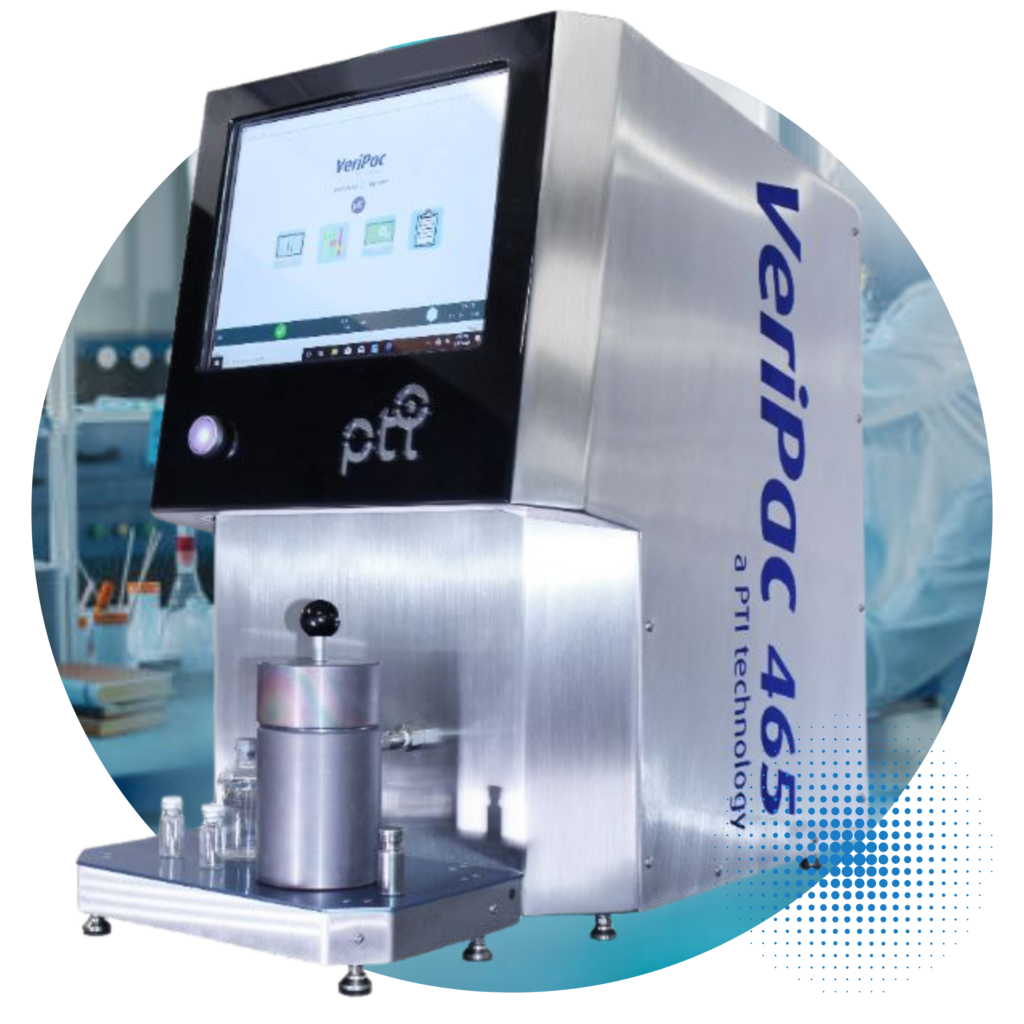
VeriPac Vacuum Decay Technology
VeriPac leak testers use vacuum decay technology to evaluate package integrity in a specially designed test chamber. The package is placed inside the chamber, vacuum is applied, and single or dual vacuum transducers monitor both the vacuum level and any change in vacuum over a defined test period. Changes in absolute or differential vacuum can indicate the presence of leaks, defects, or other package integrity concerns. Test sensitivity depends on the package design, test fixture, and key method parameters such as pressure and test duration.
This non-invasive, non-destructive inspection approach can be used with rigid, semi-rigid, and flexible packaging made from porous or non-porous materials. VeriPac systems can be configured for manual laboratory testing, offline QA/QC evaluation, statistical process control, or fully automated production applications. With test cycles that typically take only seconds, vacuum decay provides a fast, quantitative, and highly sensitive method for container closure integrity assessment, offering clear pass/fail results and the ability to detect micron-level leaks when the method is properly developed for the package configuration.
MicroCurrent HVLD Technology for Parenteral & Biologic Products
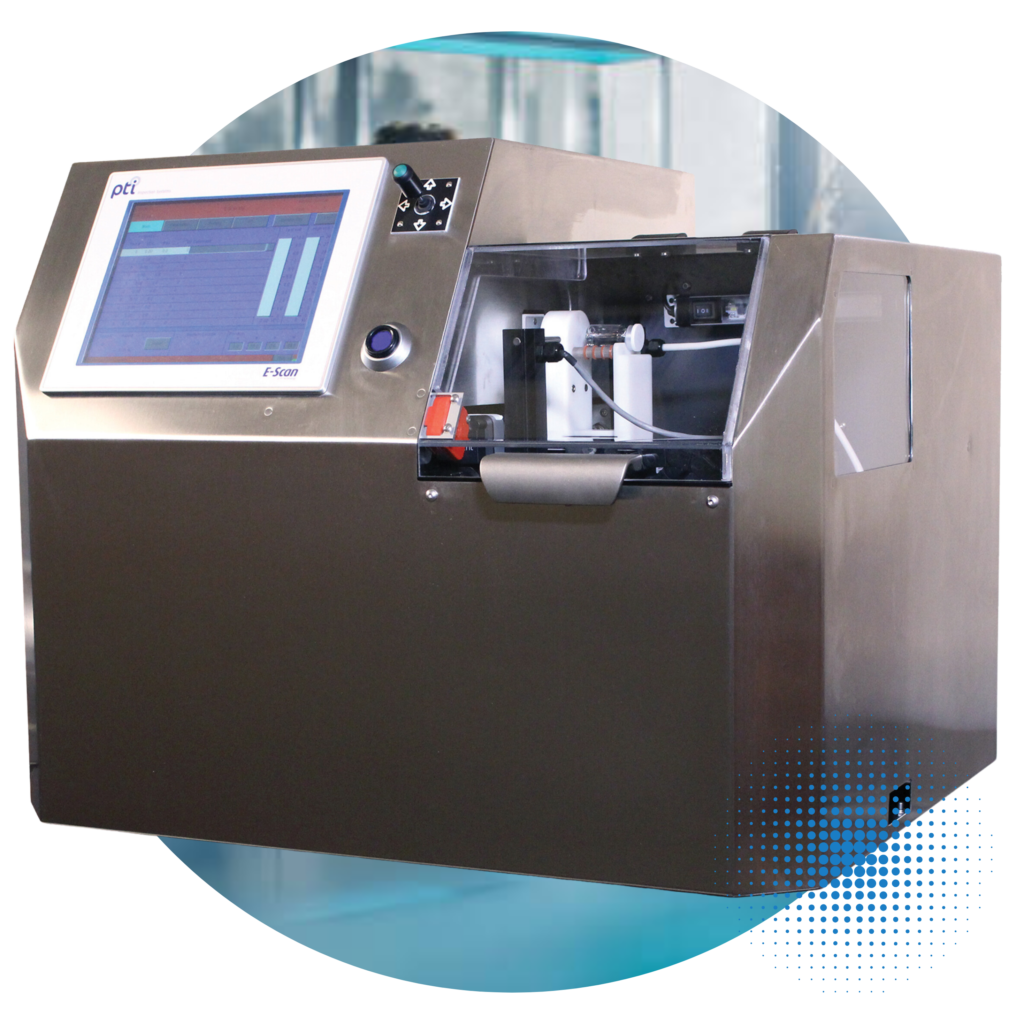
Gateway Analytical delivers traditional HVLD techniques, introducing an innovative approach to integrity testing for all parenteral and biological products, including low conductivity liquids like sterile water for injection. This novel method, dubbed Microcurrent HVLD, operates with approximately 50% less voltage, reducing the exposure of the product and environment to less than 5% of the voltage typically associated with conventional HVLD solutions.
Mentioned in USP <1207>, PTI’s HVLD technology stands as a highly sensitive method for detecting leaks in container closure integrity, applicable to a range of liquid-filled packaging such as pre-filled syringes, vials, cartridges, and ampoules.
The E-Scan procedure employs a series of electrode probes to examine a sealed non-conductive container, which may be made of glass, plastic, or poly laminate, requiring a minimum liquid fill of 30%. The presence of a pinhole, crack, or similar defect leads to a variation in resistance and current flow, signaling a compromise in the container’s integrity. This method also allows for the approximate location of the defect to be pinpointed.
Laser-Based Gas Headspace Analysis Technology for Cell and Gene Therapy Products (CGTs), Advanced Therapy Medicinal Products (ATMPs), and Lyophilized Products
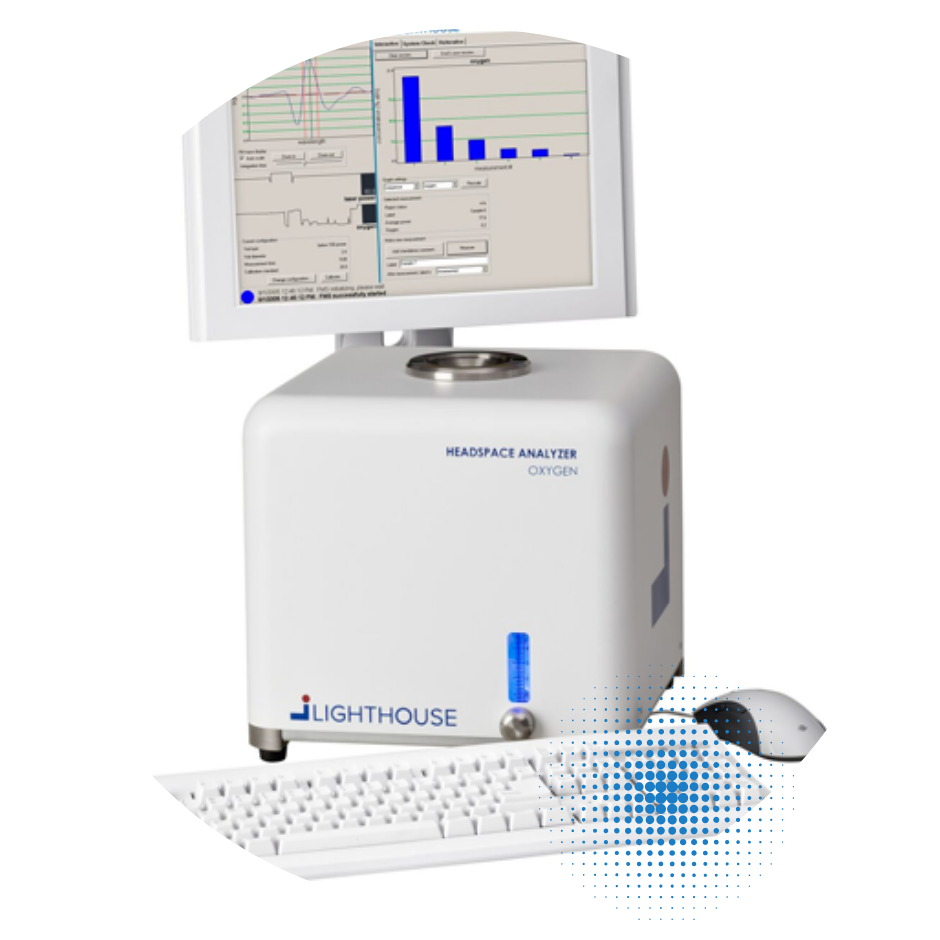
LIGHTHOUSE’s FMS-Oxygen Headspace Analyzer:
Measures oxygen concentration in sealed parenteral containers. The benchtop headspace oxygen analyzer can be used throughout the entire product lifecycle, from development to QC laboratory applications to at-line, in-process control of headspace oxygen levels and production.
Applications Include:
- Leak detection
- Container closure integrity studies
- IPC monitoring of oxygen levels during the filling of oxygen-sensitive product
- Optimization and validation of purging systems on filling lines
- Oxygen degradation studies
- Stability trends, end-of-shelf life studies
- Packaging permeation studies
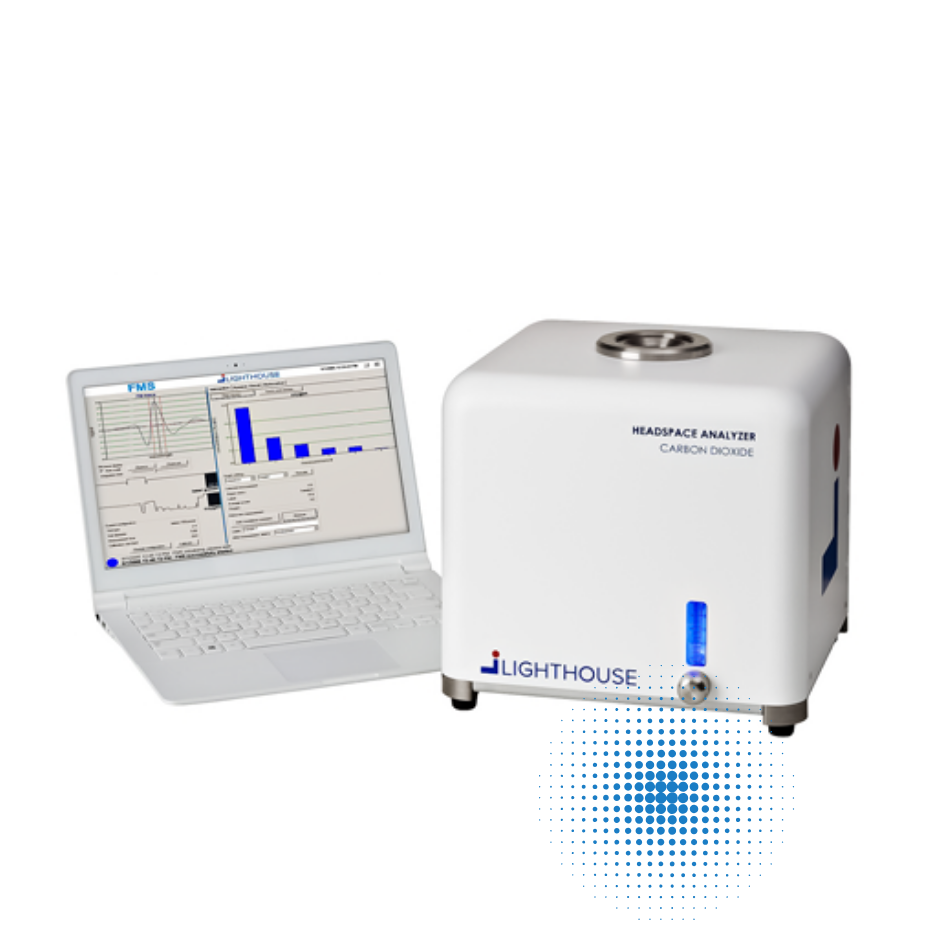
LIGHTHOUSE’s FMS-Carbon Dioxide (CO2) Headspace Analyzer:
Measures CO2 concentration in sealed parenteral containers for a variety of applications. The benchtop headspace carbon dioxide analyzer can be used throughout the entire product life- cycle, from development to QC laboratory applications to at-line, in-process control of headspace CO2 levels in production.
Applications include:
- Container closure integrity testing of frozen product stored on dry ice for transport
- General container closure integrity testing when the test method involves using carbon dioxide as a tracer gas
- IPC monitoring of carbon dioxide levels during the lling of product purged with carbon dioxide in the headspace
- Microbial growth detection in media vials
About USP <1207>
USP <1207> defines essential terms such as container-closure integrity (CCI), which refers to a package’s ability to prevent product loss, block microorganism ingress, and limit the entry of detrimental gases or other substances. Container-closure integrity testing (CCIT) refers to any package leak test that detects the presence of a package breach or gap. A container-closure system (CCS) is the sum of CCS components and materials containing and protecting the article, including primary and secondary packaging components when required to provide additional protection.
USP <1207> provides detailed information on many topics about integrity assurance, including product quality risks posed by container leaks of concern, package integrity and seal quality tests for large and small-volume container-closure systems, leaks and leakage rate, closure type and mechanics, product-package quality requirements, and the maximum allowable leakage limit, as well as inherent package integrity and the package integrity profile.

Discuss Protein Testing Needs with our Experts

- cGMP Compliant & FDA, EMA, DEA Registered Laboratory Facility
- Specialized in Particulate Identification & Material Characterization

Have a complex product-quality question? Let’s define the right analytical path forward.
Gateway Analytical applies pharmaceutical forensics, specialized analytical testing, and expert interpretation to help regulated life science companies understand particulate, package integrity, subvisible particle, and component performance challenges. Contact our team to discuss your next product.